
Happy International Women’s Day
March 8, 2026
I turn 41 today.
It's so fun to have my birthday coincide with International Women's Day. Honestly it's an honor.💜
Every year it's a moment of reflection: how far we've come, despite having so much more to do. Collectively, as a society, the work must continue.
The structural gaps are about access and visibility, but I've also been thinking a lot about how they play into self doubt.
At 6, at 10, even through high school, I had unshakeable confidence.
This picture was taken during my author and illustrator era. I would write books and draw characters, and I would walk around telling everyone I wanted to be a cartoonist for Disney.
Really.
I wish I could say that as my dreams changed and grew, I always believed in myself. I mean, it was there, but it sort of dulled over time.
Because once out in the world, I started to get messages.
Of being inadequate.
Not enough.
The messages were subtle, and the way I ratcheted up my pace as a result was hard to spot in a single moment. It was a build over time.
At each milestone, I didn't realize I was doing it.
But looking back, I know I was determined to prove everyone wrong.
Pumping in bathrooms so I could keep traveling.
Being told to "mirror" everyone else in the room (and trying to do it).
The room? All men.
It was subtle, but the cues and the overcompensating was enough to have me question my abilities, and for sure rock my confidence.
The thing is, it was always a losing battle.
The gaps and the blind spots are real, but I internalized them as ME.
Along the way, I started to question if I was good enough.
So my wish today is that as we address structural gaps, (like improving access to VC funding for women-led startups, for example, just 2% of total dollars last year), we also remember that it's more than improving stats.
The real gains will come when more girls and women NEVER stop believing.
In themselves.
In their capabilities.
In their dreams.
It's that self belief that I've come back to, and will fight like hell to make sure the next generations coming up never has to doubt it in themselves. 💜
Happy International Women's Day. I hope you have a moment to tell someone in your life why she's inspired you.
Alison
IWD Panel: Recap
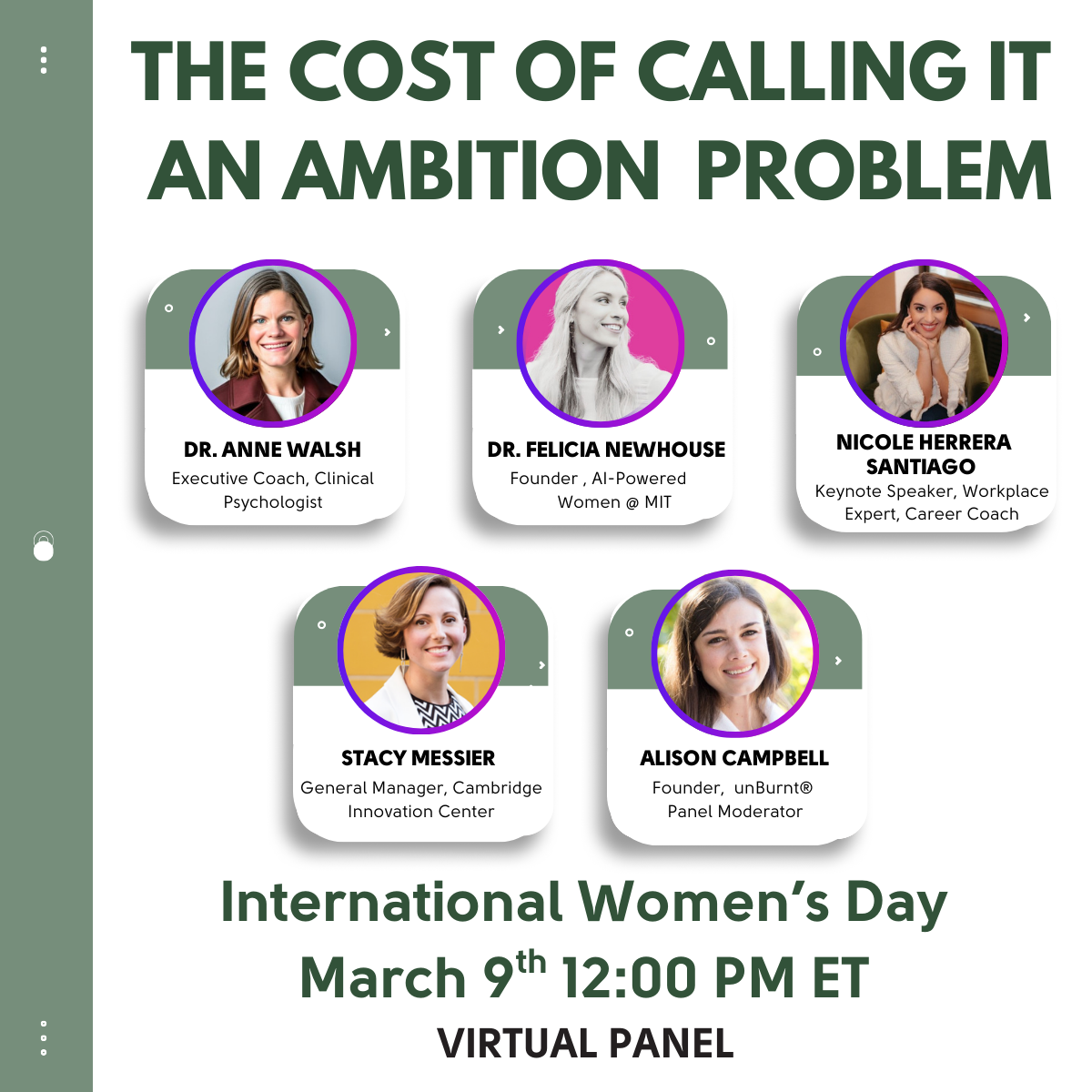
I hosted a panel for International Women’s Day, about the familiar narrative that resurfaced in late 2025: that women are pulling back at work because of an “ambition gap.” What became immediately clear how deeply this framing misses the mark.
The conversation didn’t center on whether women want leadership or growth. It centered on what happens when effort, care, emotional labor, and adaptation are constantly required, but not translated into power, advancement, or sustainable performance.
What’s being called an “ambition gap” is actually a systems gap. Women are not lacking ambition; we’re navigating workplaces and care structures that were never designed to convert their effort into equitable advancement, power, and sustainability.
Invisible labor is propping up both work and home, and women are carrying a disproportionate share of it. From emotional labor, mentoring, team glue work, and change management at work to caregiving, logistics, and household coordination at home, women are often sustaining systems without that labor being recognized, measured, or rewarded.
Real progress requires redesign, not rhetoric. The solution is not asking women to adapt harder or optimize themselves further. It is building accountability into leadership, talent systems, AI adoption, workplace design, and care infrastructure so organizations measure and reward what actually drives healthy performance.
5 biggest actionable takeaways
(1) Reframe the issue from “ambition” to “support and structure.” - Stop treating women’s advancement as an individual motivation problem. Start asking:
Are promotion criteria clear and fair?
Is flexibility penalized?
Are caregiving realities accounted for?
Are women receiving the same sponsorship and support as men?
(2) Audit the invisible work that keeps organizations running - The panel repeatedly pointed to “glue work” that women often absorb without recognition. Organizations should explicitly identify this labor, decide who is carrying it, and incorporate it into workload planning, performance reviews, and advancement decisions.
mentoring and onboarding
emotional labor and team support
culture holding
change management
informal coordination and follow-through
(3) Build accountability into business systems, not side conversations - Several panelists stressed that progress happens when these issues are treated like any other strategic KPI. That means tracking:
representation across levels and functions
promotion equity
pay equity
retention
belonging and lived experience
sponsorship access
AI training access
whether flexibility creates career penalties
(4) Redesign manager practices around real human transition points - One of the most practical points came from Stacey: don’t assume what support looks like. Ask. For example, after parental leave or during high-burden life periods, managers should have explicit conversations such as:
What do you want your return to look like?
What schedule actually works right now?
What do you need in the first 1–2 months?
What responsibilities should be adjusted or phased?
(5) Treat AI readiness as a gender and leadership issue, not just a tech issue - The discussion made clear that AI transformation is accelerating existing inequities. Women may be more exposed to displacement while having less influence over the systems being designed. Action steps include:
ensure women get early access to AI training and tools
include women in AI strategy and deployment decisions
teach AI in psychologically safe learning environments
audit who is being left out of upskilling
engage male decision-makers as allies, especially where they control capital, hiring, and technical direction
What stayed with me most from the conversation is that this is not a story about women opting out. It’s a story about how work is evolving faster than our structures are. We are in a period of rapid transformation driven by AI, economic uncertainty, and shifting expectations around caregiving and leadership.
In moments like this, narratives matter. If we continue to frame complex structural friction as individual motivation problems, we risk designing workplaces that extract more while enabling less.
But if we are willing to ask harder questions, about invisible labor, about power, about what performance really looks like, we have an opportunity to build systems where ambition can actually be sustained. Not just for women, but for everyone navigating the realities of modern work.
Featured Panelists:
Dr. Anne Welsh, Executive Coach, Clinical Psychologist
Dr. Felicia Newhouse, Founder, AI-Powered Women @ MIT
Nicole Herrera Santiago, Keynote Speaker, Workplace Expert, Career Coach
Stacey Messier, General Manager, Cambridge Innovation Center