Summer Check in: How are you doing?
July 12, 2026
I had a call with a leader this week, and before we got into any of it, we both admitted something we were feeling coming into this summer.
Every day is a quiet fight between wanting to take on the world and wanting to lie in bed, unreachable, with a book.
There is no in between.
We laughed, because it was true for both of us, and because saying it out loud made the absurdity easier to hold. Two grown women: one building a business, the other running a division of a well respected company, describing our inner lives like a light switch. On or off. Full throttle or fully horizontal.
I couldn't stop thinking about it all week. Because it reinforced something I've been mentally circling for a while.
The two settings aren't opposites. They're actually the same thing, just showing up differently. One is the wired version of empty. The other is collapse. It can feels like ricocheting between them, because those are seemingly the only two settings available, and as a society.. acceptable.
What neither of us could describe was the middle. The version where you do good work and then stop. Where you care about the thing without it consuming you, and you can rest without completely disappearing. We have vivid language for both extremes and almost none for the place most of us actually want to live.
I think that's the part we're all quietly trying to name. Not the collapse. Not the non-stop hustle. That space in between.
I also don't think the middle is a mood you can talk yourself into on a Sunday night.
So here's what I've been sitting with, and I'll ask you too. When you picture your own week ahead, do you have space for that middle setting? Or are you living on the switch, on or off, world domination or bust, with nothing in between?
In this with you and wishing you a great week ahead,
Alison
In the News: Work Trends
The Infinite Workweek (The Atlantic)
Last year, Microsoft's Work Trend Index gave us the "infinite workday," the one that bled into early mornings and late nights until it had no clear start or finish. A year later, we've graduated to the infinite workweek. A survey of roughly 1,500 workers found people describing "brain fry," a fog-like mental fatigue from overseeing tools that never stop working. One engineering manager compared managing multiple bots to having a dozen browser tabs open in your head, all fighting for attention.
AI is cutting off bottom rung (Fortune)
Stanford's Erik Brynjolfsson and ADP's Nela Richardson are tracking something their live dashboard calls the "canaries in the coal mine": workers ages 22 to 25 in the most AI-exposed roles are seeing employment shrink while their least-exposed peers keep growing. The unsettling part is the long game. If the entry-level work that used to build experience is the work AI absorbs first, the pipeline problem doesn't show up this quarter or next. It's a 5-year from now problem.
A workforce splitting in two (Lenny's Newsletter)
Segal and Rachitsky's second annual tech worker survey found self-reported productivity up, burnout also up, yet quality of work down. Interestingly, and eerily similar to the pattern we found in our Bentley research: more output on top, erosion underneath. What struck me most was the fear driving it. Not "AI will replace me," which ranked near the bottom, but being expected to do more for the same pay at a pace that's becoming unsustainable. If output climbs while quality slips and burnout surges, are we still calling that a productivity win?
Article Spotlight
New Capacity Score Diagnostic
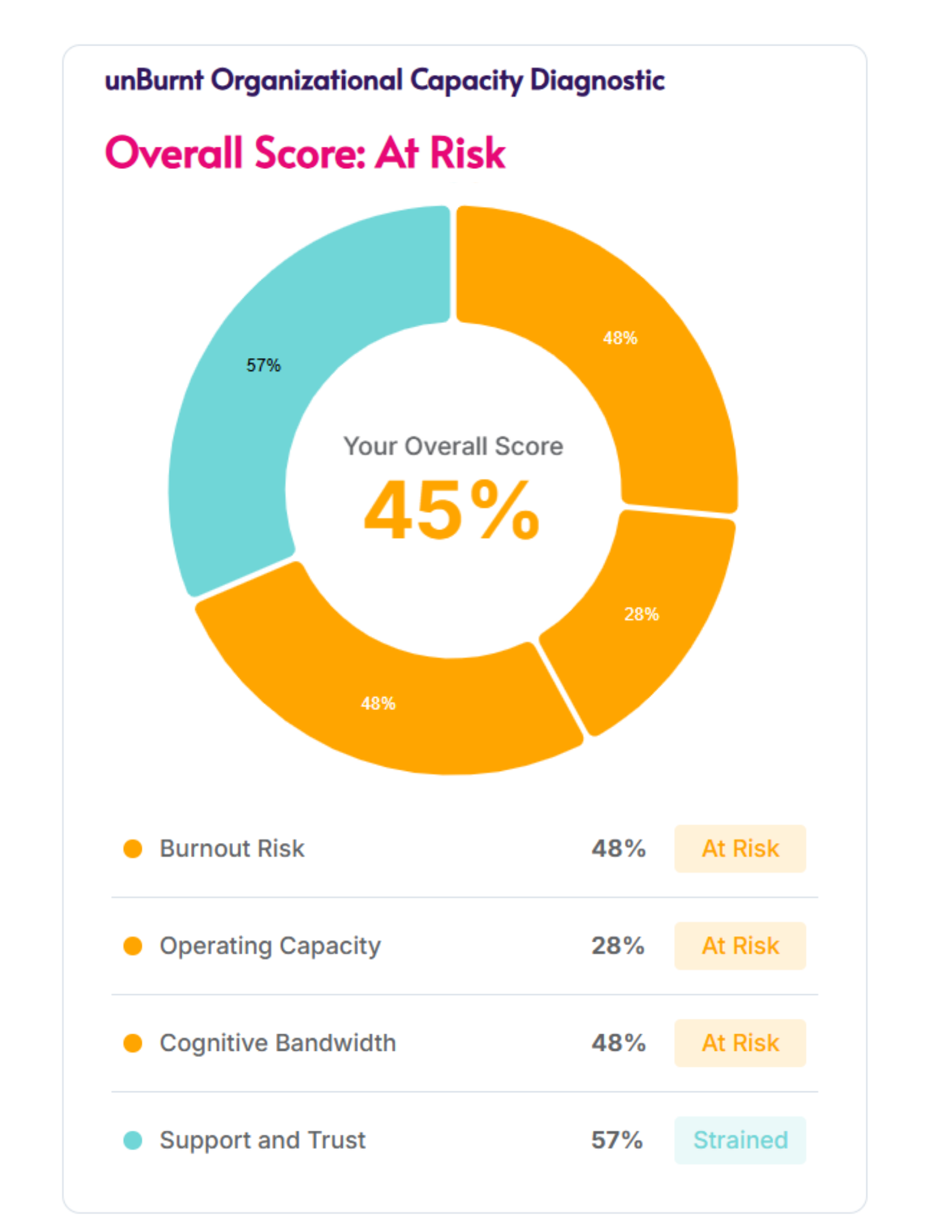
Our new Capacity Quiz measures what may still be remaining largely invisible: whether your team has capacity for innovation and sustained performance.
In 12 questions you'll get an instant read on four dimensions where hidden capacity leaks most commonly show up:
Burnout Risk
Operating Capacity
Cognitive Bandwidth
Support and Trust