Summer Check in: How are you doing?
June 25, 2026
Work isn't just asking for more of our time. We figured out how to maximize every crevice of our day a longgg time ago. And for many, we're probably still running at whatever pace we set years ago.
Increasingly, it's not just time. Work is demanding more from our nervous systems too.
It's why so many of us experience this 👇
You wake up already behind. Not behind on a specific thing. Just behind. A low-grade pressure that sat on your chest while you slept and was there before your feet hit the floor.
You're using AI to go faster, which means more gets done, which means more gets expected. What used to be impressive is now a standard expectation. The efficiency goes straight back into the system. Nobody recalibrates the ask.
Somewhere around 2pm, you notice you've made several decisions in the last hour that you're not sure about. Maybe they're not wrong, but you're rethinking. You just didn't have enough left to evaluate them properly. You keep going because stopping isn't an option anyone has named out loud.
You leave work and you're brain is still there. Because the mental load doesn't drop when the laptop closes. You're at dinner and you're turning something over in your head. You're on the couch and you're somewhere else. The people around you are getting what's left, and what's left keeps being less.
And here's what makes this era so disorienting: you cannot point to a thing that broke. Nothing catastrophic happened. You're still delivering. Still showing up. Still doing the job. The numbers probably look fine.
But you know something is off. You've known for a while. That knowing is the signal.
If you're feeling it, this edition, I'm sharing a few simple practices that may be useful to start experimenting with.
As summer slows things down just a little bit, we think we have all this time to catch up. Usually it flies by. We take some much deserved time off. And we're not ready for the avalanche that is September through December.
So if you want to approach it differently this year, keep scrolling
In this with you,
Alis
Summer Slow Down
One of the defining challenges of this era is that many of us are operating with zero margin. No buffer for the unexpected. No time for recovery. No white space in which thinking can deepen.
It feels counterintuitive to pause when everything feels urgent. The instinct is to push harder. To stay responsive. But when you are chronically oversubscribed, you are in survival mode. And survival mode narrows thinking. It prioritizes urgency over judgment. It trades long-term clarity for short-term relief.
Here are a few personal capacity practices to consider testing this summer.
1. Daily 8am Calendar Reminder (2 minutes): A simple prompt, pre-scheduled into your calendar: "How do I want to show up today?" Two to five minutes of proactive clarity can prevent hours of reactive drift.
Scan the day ahead
Choose your intention before the day chooses it for you
2. Under-Schedule on Purpose (15 minutes): A weekly gut check, either Friday or on Monday to intentionally CUT.
Stop planning for your most optimistic self
Build white space for focus, movement, recovery
If it looks tight, rebalance before the week starts
If you get off track (we all inevitably do), reset your plan for next week
3. The Driveway Pause (90 seconds)
I used to rush everywhere, including into my own house. After work, I'd race right into the night, but often without fully readying my mom-mode (or even steadying myself). I usually carried tension through the door without realizing it. Now, whether working from home or driving back, I pause.
Close one role (signal to myself that the workday has ended)
Transition intentionally into the next part of my day so I can step into it with presence
Article Spotlight

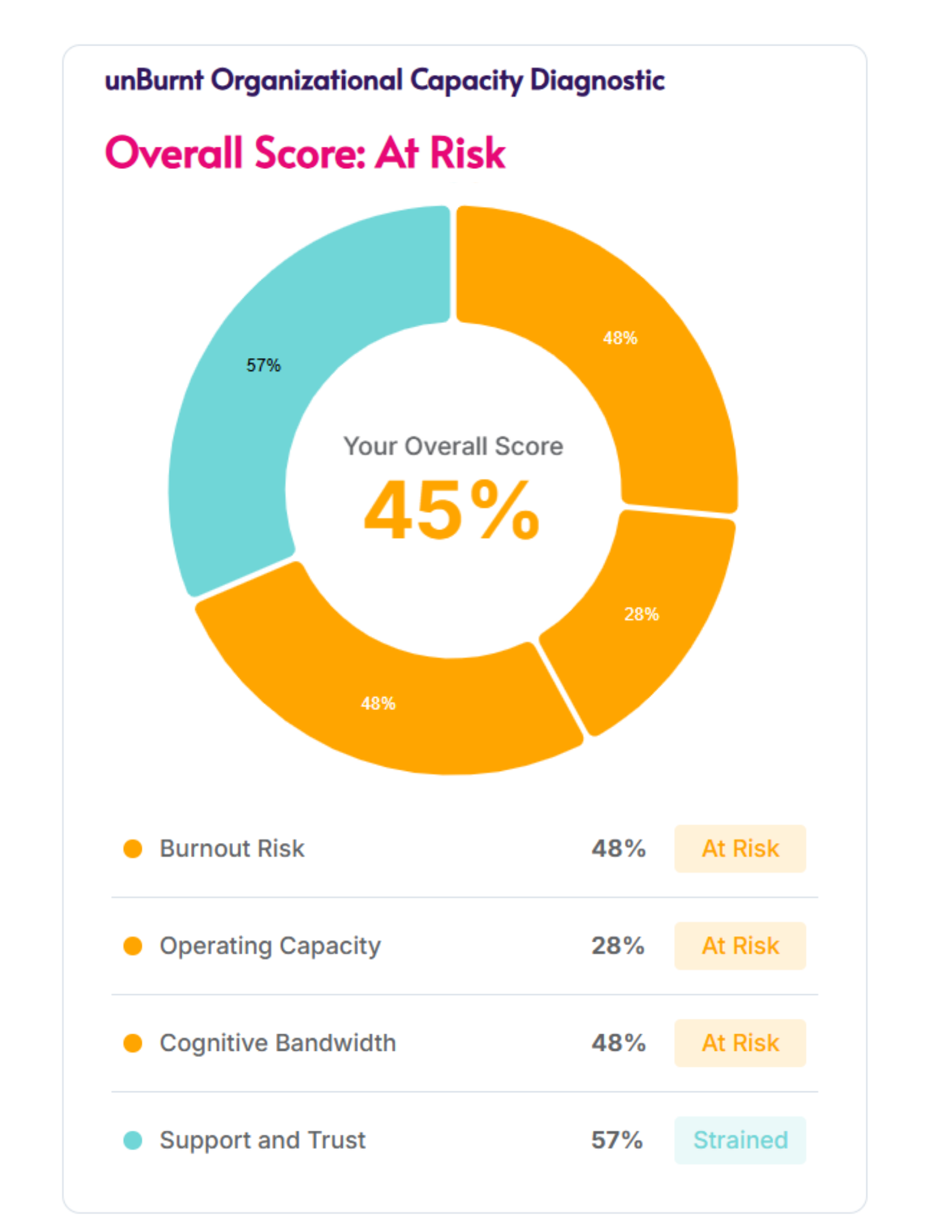
New Capacity Score Diagnostic
Our new Capacity Quiz measures what may still be remaining largely invisible: whether your team has capacity for innovation and sustained performance.
In 12 questions you'll get an instant read on four dimensions where hidden capacity leaks most commonly show up:
Burnout Risk
Operating Capacity
Cognitive Bandwidth
Support and Trust