Before you start bracing for Q4, read this
August 5, 2026
There's always a running list.
Newsletters I want to go back to read. A backlog of things to tackle that have been in my brain for a while. The newest tool everyone is talking about.
The extra tabs open in a different browser that I'm definitely going back to.
None of it is the actual work. It's the work of keeping up with the work that I find most draining. Producing enough. Fast enough. Across enough places, while staying current on things that changed since yesterday.
None of us are immune to this, whatever your role, industry, or life stage.
So I've been sitting with a question: What happens if I just... don't?
Not in a big dramatic: I-quit kind of way. But instead, it's been a reflective, slowing things down and taking stock moment (especially before the busyness of back to school and Q4 hits 🙃). A moment to ask myself where the pressure is actually coming from.
Is it the world, or is it me?
And the honest (and annoying) answer is... it's both.
The external pressure is real: a faster pace, more places to show up, an increasing avalanche of information to consume, algorithm expectations to show up or be suppressed. None of this is imaginary.
And at the same time, there are parts that are absolutely self-imposed. Holding a standard nobody asked for, but me.
Both are true.
Untangling the two doesn't make the pressure disappear.
But it does change what's actually mine to solve. And naming the what inside each lane has been the first thing that's created any room.
If this is something you're feeling too, here are three questions to ask yourself today:
What's one thing on the list I could put down without anything breaking?
What am I choosing vs. what did I absorb or reactively pick up?
What's the cost (to me) of keeping up?
In this with you,
Alison
The Physiological Sigh
The Quick Hits: Stanford neurobiologist Dr. Andrew Huberman, along with psychiatrist David Spiegel, ran a randomized controlled trial on "cyclic sighing," a breathing technique built around long, slow exhalations.
You take two inhales through the nose, a full first breath followed by a second short sip to fully inflate the lungs.
Then a long, slow exhale through the mouth.
The double inhale reinflates collapsed air sacs in the lungs, and the extended exhale offloads carbon dioxide and slows the heart, which shifts you out of a stressed state.
This is a pattern the body does on its own, during sleep and after crying, and that doing it deliberately can work in real time.
Article Spotlight: 7 Ways to Beat Burnout in Engineering
I was recently interviewed by ASME for a piece on beating burnout in engineering, a problem that's been climbing in the field, alongside leadership expert and author Jimmy Burroughes. (Psst: these tips land even if you're nowhere near engineering. They're pretty universal.)
New Podcasts
HR DataLabs Podcast
It was a treat to join David Turetsky, and breakdown the findings from the unBurnt + Center for Health and Business at Bentley University research: "When Burnout Looks Like Productivity: The New Risk to Innovation Capacity"
FoundHer Rising
For the builders who are running a company, or scaling a team, we get in to
👉🏻 A weekly reset beats a perfect routine. When the week falls apart, schedule recovery back into the next two instead of writing it off.
👉🏻 Keeping every offer open feels safe, but holding the doors open too long is what stalls a service business. Focus is what opens new growth.
👉🏻 Pushing through chronic stress puts you in survival mode, which quietly degrades your decisions and your work long before you hit a wall.
New Capacity Score Diagnostic
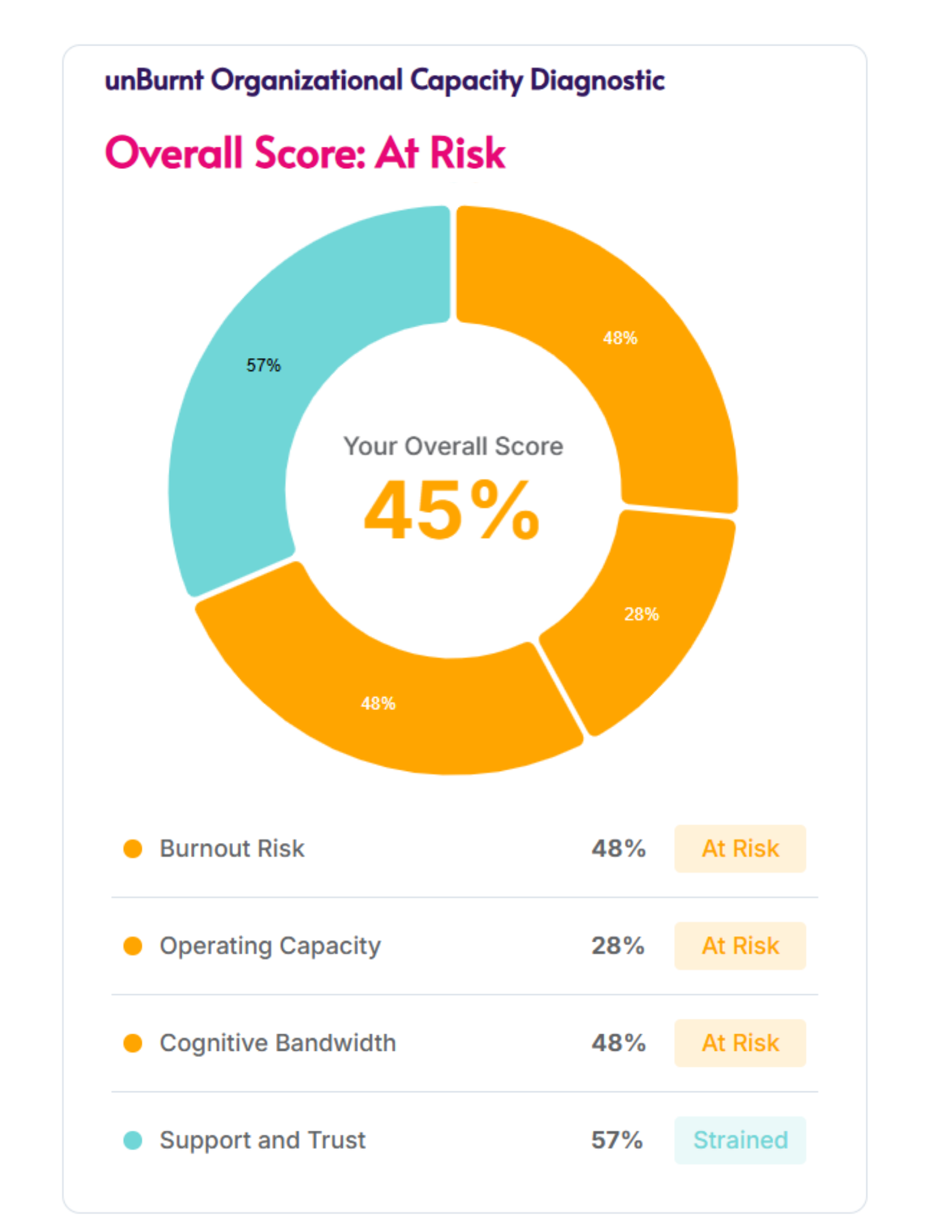
Our new Capacity Quiz measures what may still be remaining largely invisible: whether your team has capacity for innovation and sustained performance.
In 12 questions you'll get an instant read on four dimensions where hidden capacity leaks most commonly show up:
Burnout Risk
Operating Capacity
Cognitive Bandwidth
Support and Trust