We’re all looking for more Cathartic Spaces
September 22, 2026
I've spent a good chunk of September in rooms full of people circling a lot of the same themes I've been hearing for months.
Some version of: I'm feeling unsure about the future, but I'm not sure what to do about it. It's about the job market. The work itself. The news. A lot of it comes back to the AI-fication of everything, from what's happening on the ground inside the work day to what's been hitting the recent headlines.
I've been listening and watching the patterns stitch together. Underneath it all is not just the fear of the unknown. Its confusion, new (more) work to "figure out AI", whiplash, mismatched expectations, dread. The chaos about AI and how it's landing on people is real. Nobody's sure what to hand over, what to hold onto, or how fast to move. If they should solve it for themselves or wait for further instructions.
And then you look at the headlines, an ex-Anthropic researcher walking away over security concerns about whether we will actually be able to control AI in the not too distant future. The swings are getting bigger. Excitement, dread, and a hundred micro moments of uncertainty landing somewhere in between.
It almost feels like we're all collectively waiting. Holding our breaths, anticipating the next thing, but not sure when it will drop.
Living through this moment as human is a lot. It's heavy and it's full on go-mode all the time. It's also one of the reasons I'm never surprised when someone shares something really vulnerable with me. Because we're all looking for more cathartic spaces. Space to pause, and room to let go some of what we're carrying. But when we're in survival mode, it's hard to really feel any of it, so we just keep going. So maybe the work right now isn't to push harder or figure it all out. Maybe it's just to make a little room to feel where we actually are.
So take the pause. The next thing on your list will still be there when you get back.
In this with you,
Alison
Leader-led practice
One of the things I get asked all the time: how do I approach conversations with my team, collectively and individually, to check in on how it's actually going? Not necessarily the work itself, but the energy around the work.
I usually start by asking, "well, are you asking the questions"?
For many, this is very intuitive, but when sitting face to face (or screen to screen) it can also often be the first thing to go. Not maliciously, but you know, in the name of efficiency.
This is true for workplaces, or if you notice someone in your life (a partner, a friend in your community) who may look overwhelmed but it feels like asking may be the thing that piles on instead of helps.
So my advice always is: have the conversation. Make time. Ask the questions.
Here's a few simple ice breakers to start the conversation:
What's been taking more out of you than you feel like it should?
Where are you spending energy on something that may not actually matter right now?
Has anything felt unclear in the past couple of weeks?
If you want a resource you can bookmark and return to, check out my free Mindful Manager checklist including 1:1 prompts and your own energy tracker.
Brain Economy Webinar: 5 Takeaways
This week, I was in NYC for the Global Brain Economy Summit. It was amazing! Here are the 5 takeaways from my recent Webinar on how to build skills for the Brain Economy, and you can watch back here.
Activity isn't productivity. People under chronic stress still show up and respond fast, but often run at 60–70% capacity. Busy doesn't mean effective. If a weekend off doesn't reset you, watch for drops in focus, memory, stamina, and creativity, plus a shorter fuse.
Stress shuts off your thinking brain. When the brain's threat center fires, the prefrontal cortex checks out, and you usually don't notice it happening. The vagus nerve is bi-directional, so slow, deliberate breaths signal to your amygdala that there's no threat.
Your breath is the fastest reset. Belly breaths, through the nose, with a long exhale. It signals safety to your nervous system in seconds, even mid-meeting. Mechanics: 2-minute for deep belly-breathing, not shallow in the chest. Watch back for more practices.
Emotional debt: resilience without release is a trap. We're great at pushing through, but rarely intentional about releasing what we carry. A five-minute pause to name what you're actually feeling slows the stress response and hands you back control. Don't let emotional debt pile up.
Your environment shapes your biology and beliefs, and AI is turning up the pressure. The three levers aren't separate. A stressful environment keeps triggering the threat response (biology), which feeds the stories we tell ourselves (beliefs), which makes the environment feel more threatening still. AI accelerates the whole loop: faster pace, more output, fewer resets. unBurnt's research with the CHB at Bentley shows the cost: visible productivity stays high while innovation capacity quietly erodes.

AI Is Making Work Faster. But Is It Making Companies Smarter?
I wrote a piece for the Greater Boston Chamber of Commerce discussing the AI productivity race and its implications on cognitive capacity.
Drawing on my research in partnership with the Center for Health and Business at Bentley, and my continued observations of how AI-change initiatives are actually going inside companies, I was thrilled to contribute this one.
The core argument: speed and output are easy to measure, but they don't tell you whether your organization is getting better at the thinking that creates long-term value. Our research (544 professionals across 15 industries) found that employees can stay visibly busy while their capacity for focused, strategic work quietly erodes. When companies use AI to accelerate throughput without redesigning how work gets done, they risk intensifying the very conditions most tied to burnout.
If your team is moving fast on AI, this one's worth a read.
Team Capacity Score Diagnostic
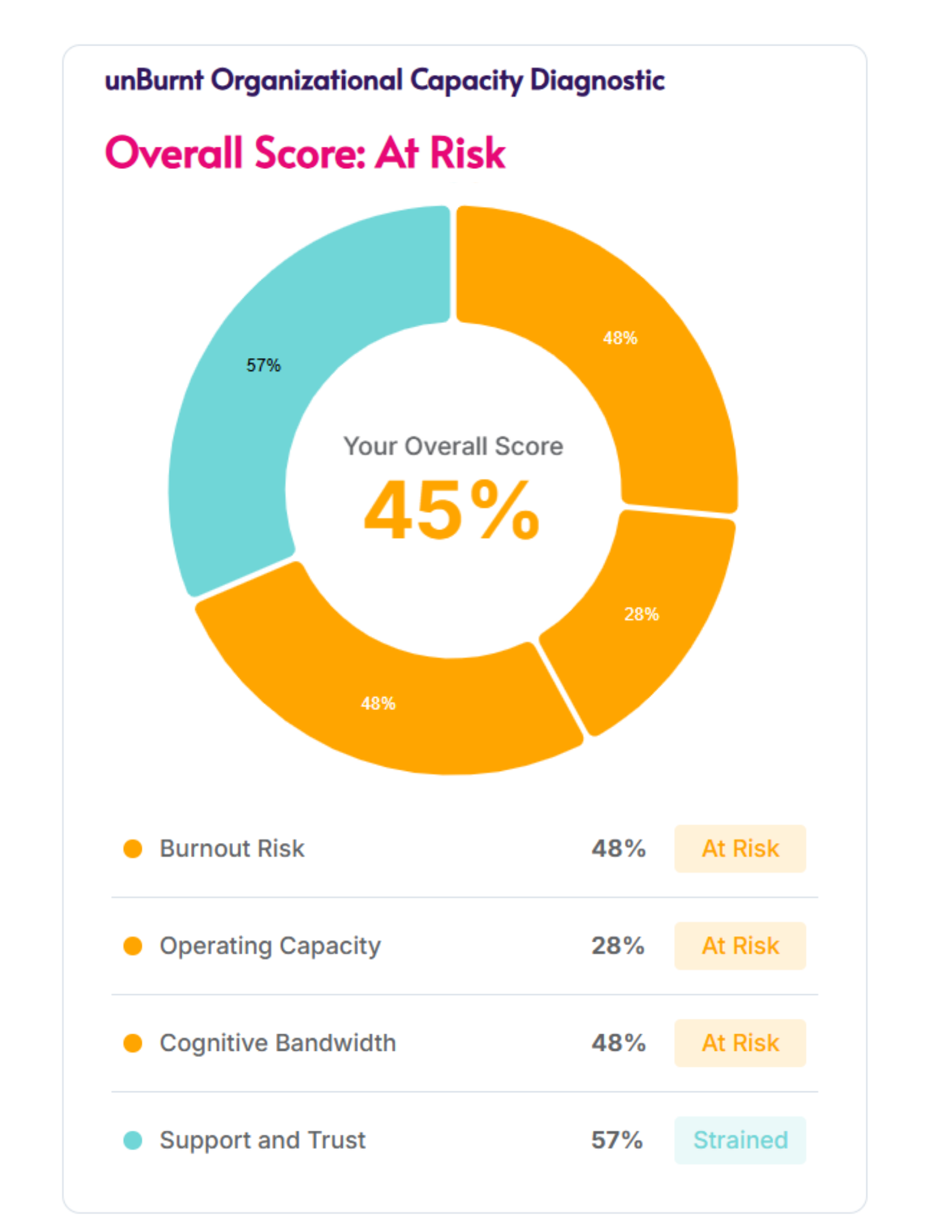
Our new Capacity Quiz measures what may still be remaining largely invisible: whether your team has capacity for innovation and sustained performance.
In 12 questions you'll get an instant read on four dimensions where hidden capacity leaks most commonly show up:
Burnout Risk
Operating Capacity
Cognitive Bandwidth
Support and Trust